
Media rodeo 29: Wartime

Media rodeo, media roundup
I started writing Media rodeo as a chance to share the media I’m consuming. Rodeos are chances for individuals to demonstrate their mastery over livestock, to prove they’ve taken up the rural mantle of disciplinary power. For this media rodeo, I will resist that will to mastery, instead offering just a roundup of media I think is important to engage this week/I’ve been engaging. (Perhaps it has something to do with the malaise that has fallen upon my social world recently…)
Late Fascism, Alberto Toscano, read here
Blood in My Eye, George Jackson, read here, thank you Seth <3
The Intolerable Present, the Urgency of Revolution, Maurizio Lazzarato, read here
“Venice Bitch,” Norman Fucking Rockwell, Lana Del Rey
You Will Never Know Why, Sweet Trip
A Girl Walks Home Alone at Night, dir. Ana Lily Amirpour
Call of Duty: Black Ops 6, Activision
videogame lol
Quinn said once that the post-October 7th movement for justice in Palestine is the anti-war movement of our time. That seems true—bourgeois life is now haunted by the ever-present specter of protest, questioning consumption has become mainstream, and US support for and participation in the genocide in Palestine had no small impact on the 2024 US election. The other side of this thought however, is that my lifetime has always been animated by war. If you were born after 9/11 in the United States, you’ve grown up in a state of perpetual warfare. A state where surveillance is the norm, where civil liberties were a nostalgic fantasy before you could even say ‘privacy’. A state where US military intervention is required across the globe to maintain the peace; we saw what a rhetorical blunder withdrawing from Afghanistan and admitting the decay of American empire was for both Presidents Trump and Biden. And most of all, the war over Palestine’s existence has been perpetually fought in its modern form since the illegitimate establishment of Israel in 1948.
(An aside: If the power of ideology in delimiting political possibility is not yet clear, my grandmother was born in 1948. When asked her why she supports Israel, my grandmother says it’s because she has ‘an affinity for the Jewish people,’ referring to the fact that the was born the same year as Israel.)
Anyways, if war is perpetual, what does it mean for this to be the anti-war movement of our time? What does it mean to be anti-war when it’s the eternal texture of modern life under capitalism?
After the systematic destruction of civilian life in Japan during WWII by the United States, a toy industry emerged in centers like Tokyo. This industry met the demand in markets like the United States for patriotic memorabilia—American kids wanted to play with military jeeps and fighter jets. Patrick Regan performs a meta-analysis of decades of studies linking pop culture objects that celebrate the military to popular American support for militarism in “War Toys, War Movies, and the Militarization of the United States, 1900-85.” He finds that more militarized toys and movies mean greater popular support for militarization; the popularity of war toys after the United States established itself as one of the great powers of the new liberal world order during WWII is no surprise.
And if this relationship wasn’t already disgusting enough, where did these toys come from? The almost complete destruction of cities like Tokyo destroyed manufacturing centers, so industrial workers needed to be creative to meet the extractive demands of foreign markets. Thus, many of the toys made in Japan and exported to the US were made from the detritus of the destruction of Japan. A firebombed city turned fighter jet. The material that allowed further militarization in the US was the consequence of military violence and indiscriminate violence. Militarism was not just reproduced through pop culture, it was the very substance that animated pop culture and produced this imperial feedback loop.
I thought of this discussion after seeing the following screenshot from Call of Duty: Black Ops 6. The franchise is inextricable from militarization at face: you play as the United States military, enacting extrajudicial killing; Call of Duty often consults with the US military and approves their scripts with the military; and the sublimation of violence through leisure certainly indicates something about the alliance between capital and war. But this screenshot is, simply put, insane:
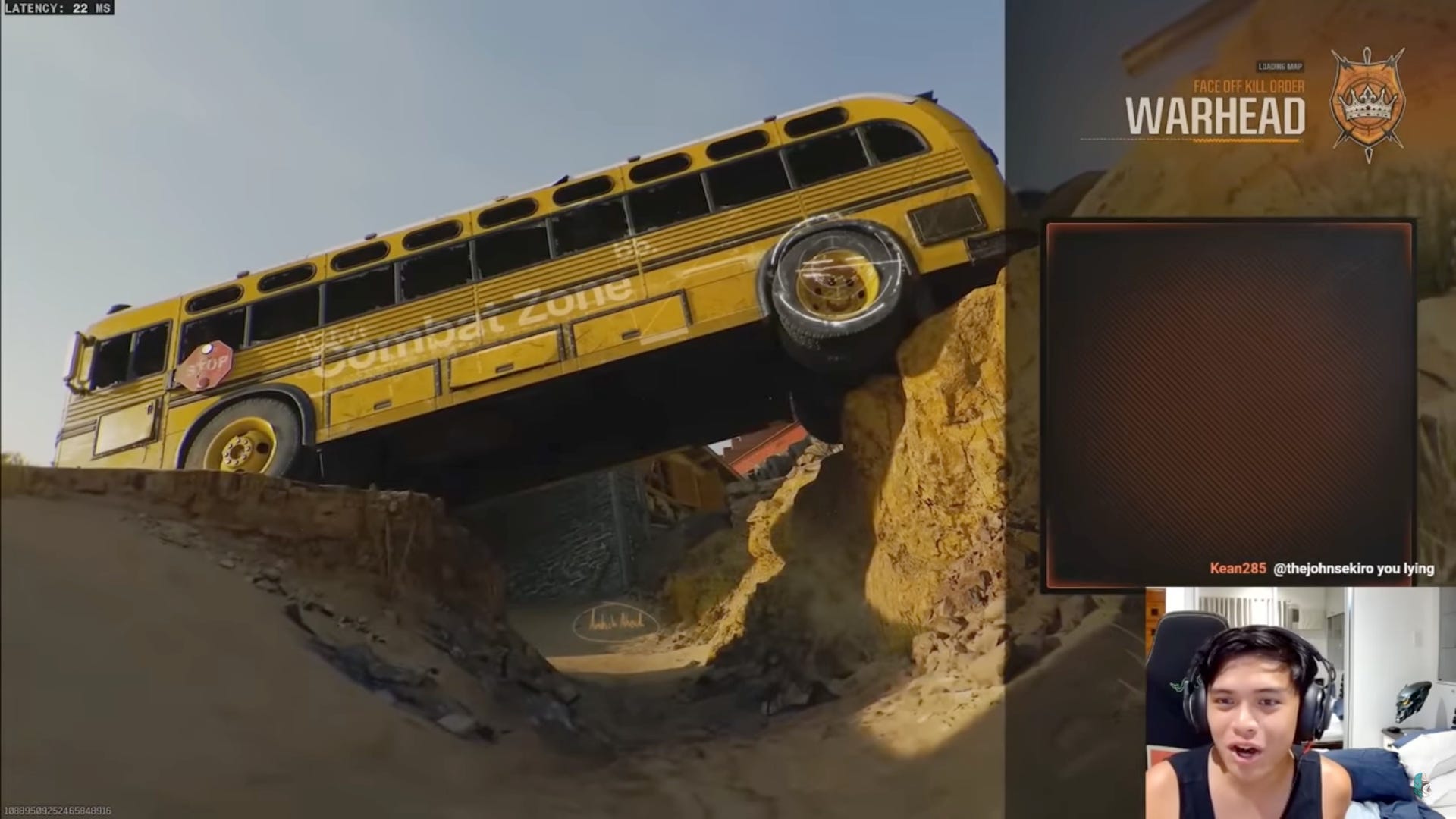
The school bus… is the combat zone… where have we seen that before? This is the loading screen for one of Call of Duty’s generically Middle Eastern maps; the player will load in, pick up their gun, and kill the enemies hiding behind the school bus. But where have we seen that before? The blatant reterritorialization of a school bus as combat zone reflects the contemporary redefinition of all space as combat space, as authors like Stephen Graham have argued (see “Cities as Battlespace”). And of course, the violent conflict that has produced the most of these images in recent times is Israel’s war of indiscriminate murder and ethnic cleansing in Palestine. They tell us Hamas uses schools and hospitals to hide from the righteous Western settlers; Call of Duty teaches us how to fight in those contradictory warzones.
Under capital today, no sign has any fixed meaning. No commodity has a fixed value. The detritus of war doesn’t work as impetus for militarization because everything is today the detritus of war; perpetual warfare has guaranteed that. Images of violence can circulate with impunity, their circulation causing outrage that simultaneously feeds back into the circuits of value that benefit the profiteers of genocide. And that is what Call of Duty reveals. This is a sign that’s been evacuated of meaning; the player should not think about what it actually means to understand a school bus as an active combat zone in the material world but should instead get ready to grind for new camos to decorate their guns. War becomes a game! And everyone wins!
Truly disgusting. War no longer provides the material for pop culture objects that justify militarization; war is now the substance of those objects. Pop culture relies upon an a priori militarization, as contradictory as that is. And the lack of distinction between pop culture and militarization is a contemporary phenomenon that fascists and neoliberals are all too gleeful to exploit. So what does it mean that we’re living through the anti-war movement of our time? It means imagining otherwise, imagining the complete deconstruction of capitalist imperialist society. It means radical action falls short when it demands anything other than total dismantling of imperialism. It means everything you consume tends towards militarism. It means that the anti-war movement cannot remain a movement to be consumed but must become a way of life, a call to arms, a quotidian reality, an inevitability. Liberation is inevitable—where will you be when it happens?